Abandoned to Ourselves by Peter Alexander Meyers
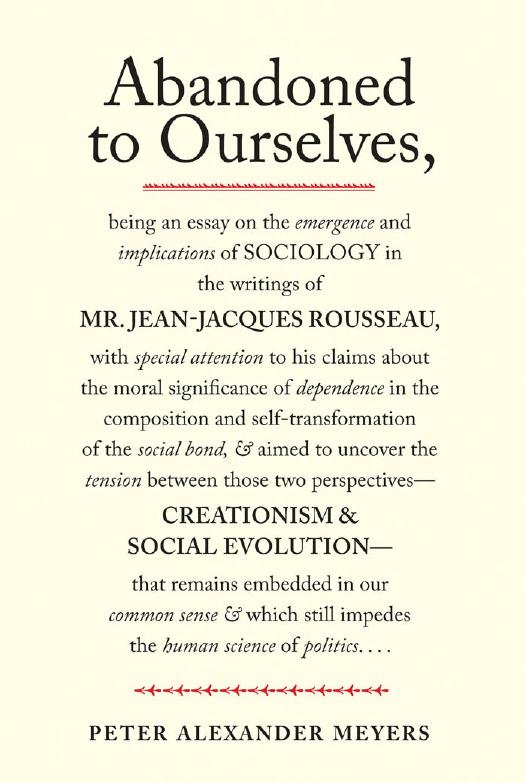
Author:Peter Alexander Meyers
Language: eng
Format: epub, pdf
Publisher: Yale University Press
Published: 2013-03-14T16:00:00+00:00
. . . to study the great book of nature, to cultivate one’s reason, to develop one’s mind, to recognize a Creator of the universe, to respect his Providence, to admire him in his works, to perceive the difference between virtue, which God loves, and vice, which he condemns, and to go through this life, in his presence, with moderation and justice, in the expectation of a better destiny after death.*
While dedicated to a Creator and mindful of his Providence, the follower of la religion naturelle gives priority to human experience of the physical over the metaphysical realm. His first text is nature, not scripture.95 The Messiah is not mentioned. The progress of this religious self is through reason, not sentiment, nor immediate faith. This is sufficient for morality, and morality is sufficient for the hereafter, whatever it may be. In this way, la religion naturelle may be said to encompass “our obligations toward God, toward ourselves, and toward others of our own kind.”96
La religion naturelle is offered as a bridging strategy in Rousseau’s social theory of politics. As such it is self-defeating and cannot carry us to Rousseau’s conclusion. Its comprehensiveness is in itself a problem. It threatens all the prevalent European religious doctrines of the time. Much eighteenth-century speculation led to the nineteenth-century fact that “natural religion” could develop into the “religion of nature.” In the minds of Spinoza’s critics, and those who embraced the critics’ view, this naturalisme was no religion at all.97
What, already in the world-and other-worldly-view described by Crousaz and like-minded thinkers, is the use of revelation and scripture? This is certainly not a new theological problem in the eighteenth century. Yet, in the period of Rousseau’s own education this question appeared increasingly urgent. “To recognize that natural religion gives happiness to man and society, isn’t that to neglect the mystery of the Fall and the Redemption, and to discount the value of Grace?”98 This discount is taking its toll. It leads Voltaire, addressing himself directly to God in the Ode sur le fanatisme of 1732, to issue this hubristic challenge: “I am not Christian, but that’s so as to better love you.”99
It is commonplace and convenient to oppose Voltaire’s God to Rousseau’s.100 But, as Jean Ehrard has made crystal clear, after “the first half of the eighteenth century the reality became much more complex than this summary dichotomy.”101 It is a complexity arising from implications for the belief in God in the age of science that follow from new beliefs both in “physics” and the emergent “anthropology.” This is a source of the inherent plurality in la religion naturelle that even while it tends against Christianity is a powerful instrument for Rousseau’s political thinking.
What is the plurality of la religion naturelle? Its compass can be roughly distinguished by its degrees. Diderot writes pointedly that
Download
Abandoned to Ourselves by Peter Alexander Meyers.pdf
This site does not store any files on its server. We only index and link to content provided by other sites. Please contact the content providers to delete copyright contents if any and email us, we'll remove relevant links or contents immediately.
| Anthropology | Archaeology |
| Philosophy | Politics & Government |
| Social Sciences | Sociology |
| Women's Studies |
The remains of the day by Kazuo Ishiguro(9091)
Tools of Titans by Timothy Ferriss(8497)
Giovanni's Room by James Baldwin(7441)
The Black Swan by Nassim Nicholas Taleb(7198)
Inner Engineering: A Yogi's Guide to Joy by Sadhguru(6838)
The Way of Zen by Alan W. Watts(6673)
The Power of Now: A Guide to Spiritual Enlightenment by Eckhart Tolle(5856)
Asking the Right Questions: A Guide to Critical Thinking by M. Neil Browne & Stuart M. Keeley(5834)
The Six Wives Of Henry VIII (WOMEN IN HISTORY) by Fraser Antonia(5559)
Astrophysics for People in a Hurry by Neil DeGrasse Tyson(5226)
Housekeeping by Marilynne Robinson(4505)
Double Down (Diary of a Wimpy Kid Book 11) by Jeff Kinney(4338)
12 Rules for Life by Jordan B. Peterson(4331)
Ikigai by Héctor García & Francesc Miralles(4312)
The Ethical Slut by Janet W. Hardy(4310)
Skin in the Game by Nassim Nicholas Taleb(4309)
The Art of Happiness by The Dalai Lama(4170)
Skin in the Game: Hidden Asymmetries in Daily Life by Nassim Nicholas Taleb(4052)
Walking by Henry David Thoreau(4002)
